
Sea-level rise used to be framed as tomorrow’s problem. It is not anymore. A new United Nations report, presented at the 55th Pacific Islands Forum Leaders Meeting in Palau on August 31, makes clear that the phenomenon is accelerating faster than at any point in recorded human history — and it is already reshaping lives today.
In 2024 alone, average ocean levels climbed by nearly six millimetres — the largest annual jump ever recorded. That may sound small, but the cumulative effect is staggering: roughly 770 million people, one in every ten on Earth, now live in coastal zones less than five metres above the high-tide line, putting them directly in harm’s way.
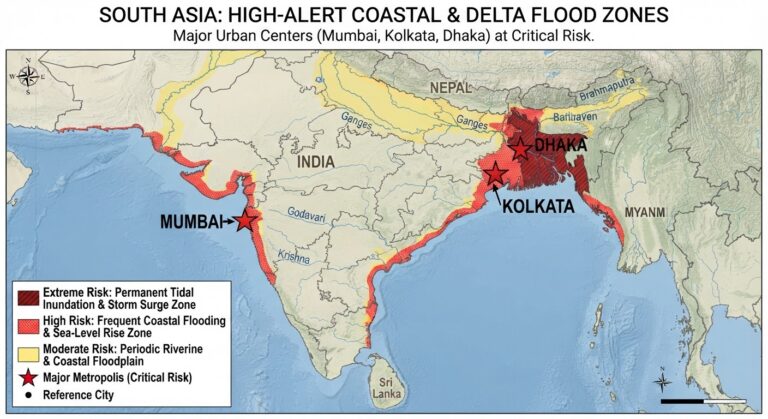
South Asia is on the front line. In India, cities like Mumbai and Kolkata — along with Dhaka in Bangladesh — sit in low-lying deltas where rising seas are compounding with land subsidence to intensify flooding. More than 14 million people across these areas face the immediate risk of losing their homes to permanent inundation, as saltwater increasingly contaminates drinking water, soil, and farmland.
Europe isn’t immune either. Roughly 70% of Germany’s coastline is retreating due to erosion, while France’s Riviera has lost about half its beach area since the late 1800s. In the UK, a projected metre-plus rise by 2100 could put one in four English properties at flood risk by mid-century.
The scale of what is at stake globally is hard to overstate. Without urgent adaptation, the UN warns that up to 1.2 billion people could be displaced by 2050. Some Pacific Island communities have already begun relocating. Economically, existing coastal infrastructure damage tops $1.8 trillion, with annual losses potentially reaching $4 trillion a year by century’s end.
Beyond economics, this is fundamentally a human rights issue — threatening access to housing, clean water, food, and healthcare, with Indigenous Peoples and small island populations bearing the heaviest burden, including the loss of ancestral land and cultural heritage.
The UN’s report isn’t just a warning; it’s a call to action, laying out 18 recommendations spanning emissions cuts, early warning systems, climate financing, and stronger legal protections for at-risk populations. The message is unambiguous: this crisis is unfolding now, and the response needs to match its urgency.
Headlyne app makes sure that as soon as a headline is created, it reaches straight to your phone without wasting any time! Stay curious and informed with us.
Download the Headlyne app today.